Friday, 16 September 2011

Love and food in the Appennines 2

An embarrassment of riches 
Sunrise over the Apennines
The grape harvest is now under way. The sun has burnt off the morning mist and three men in hats and bright shirts, carrying buckets, appear in the terraced field above the second bend in the road below the house.  They move slowly and methodically along the lines of vines and occasionally their voices float up towards us on the light breeze. This reminds me that there are several large bowls of grapes sitting accusingly in the fridge, together with the large box full bought for 80 cents at Leclerc on our first morning.  It seemed a good idea at the time, before we became the recipients of local generosity. 

A natural resistance to wasting food, made even more acute by the sheer pleasure of receiving such fresh and organically produced beneficence, obliges me to do something productive with the large bunches of black and white grapes we have received. Here are two of the solutions cooked up in the kitchen at Casa Barile.


Tipsy quail
Sear four quail in a little olive oil,  put into a casserole dish with pepper and salt, then pack down, round and under them a generous quantity of white grapes, stemmed and washed. Pour over a glass of Prosecco (which is what happened to be at hand, but any white wine will do.) Cover and pop into a medium oven for about 30 minutes until the quail are cooked.

Grapevines lining the driveway
Remove the birds and pop back into the oven in a small tin  for five minutes to crisp and brown the skin, then keep warm whilst you make the sauce. Keeping aside a couple of spoonfuls of grapes, push the rest with the cooking juices through a fine sieve, put into a small pan and reduce if required to a consistency of pouring custard.  In a small bowl, beat an egg yolk with a large dollop of plain yoghourt (or cream if you have it) then mix in a couple of tablespoons of the hot sauce before adding the egg mixture to the pan. Stir well over a very gentle heat, season to taste and serve with the quail, garnished with the reserved grapes.

Sober juice
Delicious though tipsy quail are, I realise that I need to scale up my grape management. So thanks to a Californian website,  and to a husband's prediliction for large, white, fine cotton handkerchiefs, we now have a virtuous beverage in the fridge to enjoy before the sun disappears over the yardarm.

Too hot to tread....
Take 2 kilos of black grapes, stripped from their bunches and washed. Put in a large saucepan and bash firmly with a potato masher. Then put on a low gas and bring to a gentle simmer. After five minutes give another vigorous mashing, to encourage  the juices to escape, and cook for another ten minutes. 

Line a large sieve with cheesecloth, or as in my case,  line a colander with a large freshly laundered handkerchief, and pour over a kettleful of boiling water.  Position the lined colander over a large bowl,  carefully ladle in the grape mash (advisable to wear a large apron or least favourite  clothing) and leave to drip through for several hours. 

To speed the process, after three  hours I tied the four corners of the handkerchief together with string and hung it from convenient doorknob over the bowl as if making jelly (see earlier blog Wild and free - or the art of self-preservation ). The weight of the mash helps to extract juice more quickly. 
  
Husband hard at work at his easel 

Then refrigerate the rich, gloriously coloured liquid and use within a week. Serve diluted with still or sparkling water and decorated with a sprig of mint, borage, lemon balm or whatever is to hand in fridge or garden. 

General notes: 
Yield is about 500 cl from 2 kilos of grapes. Handkerchief turns a stylish patrician purple, a useful description when explaining unconventional use to owner.

All photographs by Sandi

Thursday, 15 September 2011

Love and food in the Appennines


Casa Barile
The road to the house, in Tuscany's wild and wonderful Garfagnana, is a heart-stopping series of steep, hairpin bends, with an occasional widening to provide sanctuary from oncoming vehicles hurtling towards you with confident and complete ownership of the narrow ribbon of tarmac. On one side the rockface towers high above, on the other, the road drops away into a wooded cliff down to the river, with some stretches offering the comfort of battered metal railings. The road is the only route in or out for a dozen or so villages, smallholdings and an agriturismo, so as well as cars of various size and age,  you are likely to meet the local bus, forestry lorries and buzzing scooter drivers convinced of their own immortality. 

Thus it is with a mixture of anticipation and trepidation, (and a dash of satisfaction at identifying a new route around the challenging ramparts of Lucca) that we embark on the last leg of the journey from Pisa Airport. We turn off the main road, the junction made even narrower by two men with a lorry rebuilding the retaining wall, cross the slim bridge over the Serchio River, bump over the railway track, negotiate the parked car and dozing dog outside Claudio's bar and begin the ascent.

Jointly swearing to pay the extra money for automatic transmission next time, we negotiate into the steeply curving  drive, through the iron gates,  past the vines dripping with grapes and park by the house, its solid stone walls and red-tiled roofs as lovely as we remember. We unpack only to locate swimsuits, click the automatic pool cover and sink into cool, welcoming water just as the sun dips down behind the mountains, turning the sky to rose and lavender.

Sunset in the Garfagnana

Warm welcome
Natalina's basket
The afternoon after we arrive,  a car sweeps up the driveway, unannounced. Out bustles Natalina, with husband Bruno, welcoming us back in non-stop Italian and kissing us exuberantly on both cheeks, before handing over a large basket filled to the brim with five varieties of tomato, nine eggs laid that day,  bunches of small, sweet grapes and a bunch of basil large enough for a bridal bouquet.

Assuring us that Natalina would come as agreed in a week's time to clean the house, the pair then disappear back down the drive in a flurry of dust.

The previous year's visit had been somewhat marred by breaking my right wrist on the very first morning. Now I am looking forward to able bodied enjoyment of the house.  One of its main attractions, apart from the high ceilinged rooms, the swimming pool and choice of terraces, is the kitchen, which runs the full width of the house with windows on three sides taking in the wonderful views.
A sink with a view


Just as well, I ponder, surveying the bounty delivered by Natalina, knowing that the fridge is already full of fruit and vegetables purchased that morning. The tiny cherry tomatoes strung like jewels on their long branches are deliciously sweet and thin skinned,  as easy to eat as sweeties.

But now was clearly the time to make all those recipes which call for full blooded, red-all-the-way-through, lumpy but fragrant tomatoes. In other words, the tomatoes you get when you grow them yourself and the weather is kind. Or Natalina calls by with a basketful.


Sweet intensity
Roasted tomatoes
Skin large tomatoes, slice in half around their middles and arrange on an oiled roasting tin, close but not touching. Trickle oil over each half, grind on some salt and black pepper, sprinkle with a little crushed garlic and top with a basil leaf oiled on both sides. Pop into a hot oven and roast until soft and blackening around the edges. Serve warm or cold with plenty of crusty bread to mop up the juices. (If any get too pulpy, just add them to a tomato sauce, stir into pasta, add to roasted vegetables......)


Pure and simple tomato sauce
Skin and roughly chop about a kilo of ripe tomatoes (if using up some of the cherry variety don't bother to skin) whilst a couple of chopped, large, red onions are cooking gently in olive oil in a large pan. Add some crushed garlic and stir for a couple of minutes before pouring in the tomatoes followed by salt, pepper and if you wish, some organo.  Leave to simmer gently whilst you have a glass of wine on the terrace, empty the dishwasher, catch up with emails or whatever until the sauce becomes thick, fragrant and full of natural sweetness. (Check every now and then, especially if you go for the glass of wine option, to make sure the sauce is not sticking to the pan.)

Keep in the fridge and use in all sorts of ways, on top of bruschetta (although Italians insist that the tomatoes should be chopped and raw), stirred into pasta, added to roasted aubergines and courgettes,  transform left over cooked chicken with a handful of olives......

Don't forget to check the sauce....


Wednesday, 31 August 2011

A pie of note


More than half baked...

It was ironic that after Lord Sugar’s derogatory remarks about engineers being useless at business, the winner of The Apprentice was the self-deprecating engineer Tom Pellereau.* Many watching the show hoped that he would be announced joint winner with his fellow contestant Helen Milligan. Indeed, it was only the change of contest rules that prevented the intelligent, effective, efficient, charming (and yes, beautiful) Helen from walking away the clear winner. After all, the pie business that got both contestants into the final was firmly based on her business acumen and experience with a national bakery company.

So maybe that was why making a traditional pie came to mind when planning for another British tradition, a picnic combined with grand opera. “Avoid sloshy food,” intoned husband, mindful of white dinner jackets, silk frocks and the ominous weather forecast for Glyndebourne that weekend. So sturdy food it was to be.

And what could be sturdier than a raised hot water crust pie, originally devised not only as a way of keeping in delicious meat juices without requiring a lidded casserole dish but also to withstand the rigours of transportation by horse drawn coach over rutted roads in the 18th Century. It had been several years since I last enjoyed the tactile pleasure of moulding warm, smooth pastry up the sides of a tin and making flamboyant decorations for the lid.
Layering the pheasant and pork mince

I decided game was the appropriate filling, as the opera that evening was Rusalka, which opens with a royal hunting party in the Bohemian forest. The breasts of a brace of pheasant were marinated in brandy before being layered with spiced minced pork in a hot water pastry crust lined with smoked streaky bacon. The pheasant carcasses were simmered for three hours with herbs and vegetables and the resulting liquid boiled down hard to make an intense stock that would turn to a tasty jelly when cold.

The fun bit...
Removing the pie from its tin for final coating of beaten egg and a further ten minutes in the oven was a nail biting process, despite using a brand new, non-stick, loose bottomed cake tin. More grease next time, I think. The other challenge was ensuring that enough of the liquid stock could penetrate throughout the central hole in the pie to fill the gaps caused by the filling shrinking during cooking. A slow process, but next time I am tempted to drill a couple of additional holes closer to the pie sides, where the biggest gaps are created.

Cut and come again...
Was it worth the work? Absolutely. The Glyndebourne pie gave 12 generous portions and held its shape to look appealing the second (and third) time it appeared on the table. I cannot bring myself to spend £100 on one of those traditional clip fastening pie moulds made by only one company, in France. But I have bought a couple of 4 inch diameter pork pie tins to create tasty pies on a smaller scale – just the thing for picnics, after theatre suppers or lunch following a long muddy walk.

And the opera was magnificent. 


* (See Sugar and spice and all things nice, at http://constructivewomen.blogspot.com)


Raised pheasant pie
Filling
500 gm of minced pork (fatty rather than premium lean)
500 gm of thinly cut streaky bacon rashers
500 gm of pheasant, cut from the bone
3 tablespoons of brandy
1 heaped tablespoon of chopped parsley
1/2 teaspoon each of nutmeg, cinnamon, ground cloves
salt and pepper
approx 450 ml of jellied stock (made from the carcasses, or bought)

Hot water crust
450 gm plain flour
200 ml water
175 gm lard
1/2 teaspoon salt
scant tablespoon icing sugar
beaten egg

Method
If making your own stock, prepare the day before and leave to cool. Mix the pork mince with two or three of the bacon rashers chopped small and add the spices, parsley and seasoning. Cut the pheasant meat into neat pieces, about 5cm, and leave in a covered dish with the brandy and some salt and pepper. Keep all the meat cool whilst preparing the pastry.

Sift the flour with salt and icing sugar into a large bowl and make a well in the middle. Bring water and lard to the boil in a medium sized pan and pour into the well, mixing it with a wooden spoon. (Take care when pouring the water and lard, as it can splatter up dramatically against the side of the pan.) Keep mixing until the pastry forms into a smooth, elastic ball. Cover and leave in a warm place for it to cool enough to handle comfortably.

Smoothing the warm elastic dough...
Put about a quarter of the pastry on one side (for the pie lid) and put the remaining pastry into a well greased cake tin (approx 18 cm diameter, 8 cm deep) with a removable base. Shape the pastry up the sides of the tin, making sure that the base is evenly covered and that there are no cracks or gaps. If it slides down the tin, the pastry is a little too hot, so leave it for a few minutes before trying again.

Line the bottom and lower sides of the pastry with the bacon rashers, followed by a layer of mince, a layer of pheasant, a layer of mince, a layer of pheasant and finally a layer of mince. Pack the filling in gently, mounding it slightly in the middle. Pour in the remains of the marinade brandy.

Moisten the rim of the pastry with beaten egg and top with the reserved pastry rolled out for the lid. Knock up the edges and trim, make a hole in the centre and insert of small tube of rolled card (to let the steam out and to allow the jelly to be poured in after cooking). Brush the lid generously with beaten egg. Have fun cutting out decorations from the pastry trimmings, position them on the lid and brush again with egg.

Bake for 30 minutes at Mark 6, 400 degrees F, 200 degrees C, then lower the heat to Mark 3, 325 degrees F, 170 degrees C for a further 1.5 to 2 hours. Remove from the oven, allow to cool a little then carefully remove from the tin (leaving the pie on the loose base), brush the sides with beaten egg and return to the oven for another 10 minutes or so to brown.

Gently does it...
Remove the pie from the oven and whilst still hot, carefully remove and discard the card roll from the central hole and gently pour the stock, warmed up sufficiently to be just liquid, into the pie, allowing it to flow into the meat and fill the gaps. This is requires patience and it is tricky to gauge the amount, but the pie should take at least 200 ml of stock. Leave the pie overnight before serving. 

Serve with damson jelly (see Wild and free blog).  


Wednesday, 24 August 2011

Wild and free – or the art of self-preservation


On family walks when I was a child, my mother always had a couple of bags in her pocket, for blackberries or crab apples, chestnuts or cob nuts, sloes or rosehips. She saw the invention of the polythene bag as a particular gift to foragers, especially when it came to the juicier fruits. In later years mum believed that the environmental impact of too many plastic bags was cancelled out by the benefits of gathering nature’s beneficence. She was also of the generation that washed and dried her plastic bags for re-use.


Foraging remains an important part of our walks in the country, not to mention in towns and cities too. A couple of years ago we discovered in the valley half a mile or so from the cottage, a clump of wild damson trees laden with small round purple fruits. The bounty generated jars of sharp and flavoursome plum jam, rekindling enjoyment in teatime toast and sponge cake. I also discovered the pleasures of crystal clear, crimson damson jelly, which heightens the flavour of roast meats and game. Not to mention the thrifty satisfaction of converting the leftover pulp from jelly making into damson cheese - just as delicious with cheddar and brie as those smart little pots of membrillo from upmarket stores..


Alas, hopes of replenishing the store cupboard last year vanished thanks to a broken wrist. So it was with great anticipation that we set off last week down into the valley to inspect, and hopefully gather, the 2011 wild damson harvest. Grandchildren entered into the foraging spirit with gusto, especially four year old Finlay, who was keen to use the bent-wire-coathanger-on-a-walking stick tool devised to reach the higher branches.


We returned with three kilos of damsons, plus another two kilos of larger and sweeter fruit discovered on plum trees in one of the secret little lanes that criss-cross the village. Then we picked a few of the apples from our tree to add to the blackberries from the brambles in the churchyard for a quick pudding.


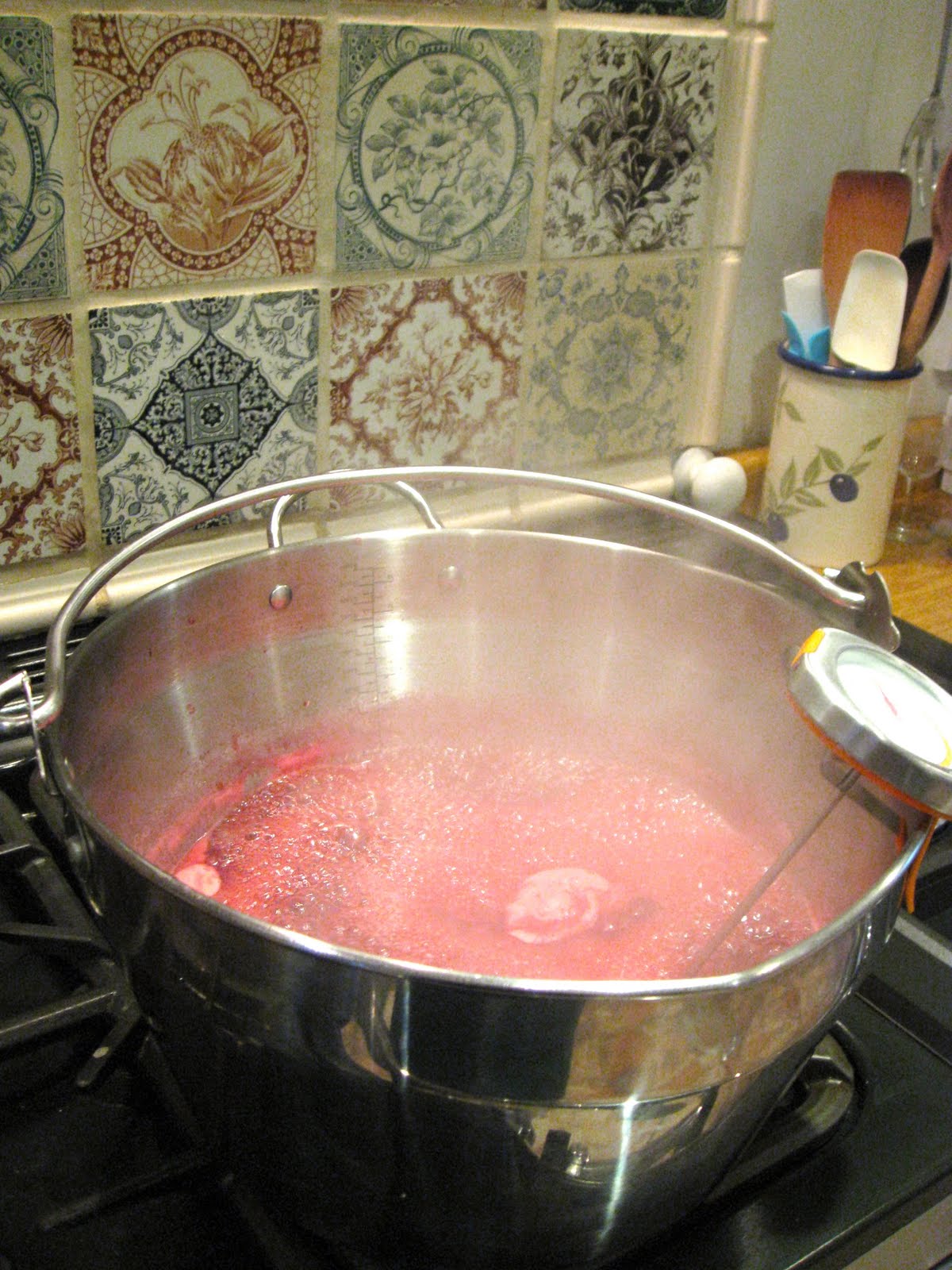
The next evening, as I gathered jam jars and jelly bags for sterilizing, rinsed the preserving pan, organised thermometer, labels and pens, the sky above the hills turned to a glorious crimson – just the colour of damson jam as it bubbles and swirls in the pan.


And a few days later, my larder is re-filled with pots and jars of preserves of fruits foraged and gathered for free. The only costs are sugar and vinegar from the village shop, plus the cooking fuel.


Wild damson jam

Put one kilo of damsons, washed and with stalks removed, into a preserving pan with 1.4 litres of water. Bring to the boil and then simmer gently until the fruit is soft. The dark skins will split, revealing golden flesh and then the whole lot turns a lovely rich crimson.


Add one kilo of granulated sugar, stir until completely dissolved and then bring to the boil. The small stones will begin to float to the surface, so scoop them up with a perforated spoon and then remove them with a teaspoon. (Sounds fiddly, but far, far easier and quicker than stoning damsons before cooking.)


Cook at a fast boil for a set (105 degrees C or 225 degrees F on a sugar thermometer). Remove from the heat and leave to cool for 10 minutes, skim off any scum and remaining stones, then pour carefully into hot, sterilized jars and seal. Label when cold.


Damson and apple jelly

The beauty of jelly making is that you don’t need to stone or peel the fruit first, simply wash. Put 900g of damsons into a pan with 450g of tart apples, (chopped and including cores and skin), 150ml of cider vinegar and 750ml of water.


Bring to the boil, reduce the heat and simmer until the fruit is soft and pulpy. Pour the fruit and juices carefully into a sterilized jelly bag suspended over a large bowl and leave to drip (at least three hours, or preferably overnight.


Measure the strained juice into the cleaned preserving pan, adding 450g of granulated sugar to every 600ml of juice. Bring to the boil, stirring to ensure the sugar is dissolved, then boil rapidly for a set (105 degrees C or 225 degrees F).


Remove from the heat, skim any scum, then pour into warm,

sterilized jars. Cover and seal while hot. Use within two years.


Damson and apple cheese

Remove the pulp from the jelly bag, stir in enough hot water to make a soft puree, then push through a sieve.Weigh the puree and put into a clean pan with an equal weight of sugar (eg 450g of sugar to 450g of puree). Stir to dissolve then simmer the mixture until it is so thick that the spoon leaves a clear line when drawn across the pan. (I call it the Red Sea test). Stir frequently to avoid sticking and burning. Spoon the fruit cheese into warmed sterilized jars (preferably with straight sides) and seal. Alternatively put into small ramekins, cover with cling film and refrigerate - but eat within a month.


These recipes come from the excellent The Complete Book of Preserves & Pickles, Jams, jellies, Chutneys & Relishes, written by Catherine Atkinson and Maggie Mayhew. ISBN 1-84477-016-8. The book also contains very useful advice on sterilizing and sealing, together with stockists of preserving equipment.


All photographs taken by Sandi in her Cotswold kitchen.

Wednesday, 1 September 2010

A bird in the bush is worth a brace in the fridge

Harvest time is fast approaching and the process of clearing the freezer and larder in preparation for the processing of apples, damsons, blackberries and irresistible bargains of the shooting season revealed a brace of pheasant overlooked since January (see previous story). A hearty game casserole felt inappropriate for August, despite the chill winds and gusting rain, but the arrival of house guests and dinner for ten spurred me to cook a terrine.

A terrine takes the slow cooking of minced meat and offal to a more elegant level than meat loaf or pate de campagne, encouraging all sorts of creativity. Nevertheless, the thought of using two complete birds also brought out my frugal side, so after the pheasant were boned out (the breast fillets kept whole and the rest of the meat whizzed in the food processor) the carcasses were roasted with a splash of olive oil for ten minutes, before the tin was deglazed with a splash of red wine. The bones and juices were then simmered with an onion studded with two cloves, a couple of carrots, a dried pea pod and a bay leaf, and water to cover by an inch or so.

Whilst the stock simmered, the minced pheasant was mixed with a pack of minced veal and minced pork, a finely chopped onion, clove of garlic, a handful of brown breadcrumbs, seasoning, a beaten egg and a generous slug of marsala wine. A loaf tin was lined with streaky bacon (stretched with back of knife to ensure thin strips long enough to encase the filling) then half the minced meats added, followed by two lines of delicious, rich brown, air-dried, preservative-free Hunza dried apricots interspersed with pistachio nuts, followed by the breast fillets, more apricots and pistachio nuts and then the remainder of the mince mixture.

Finally the ends of the bacon strips were wrapped across, two bay leaves popped on top and a foil lid secured. The terrine was put into a roasting tin half filled with boiling water and carefully put into the oven (gas mark 3) and left to cook gently for 1 hour 30 minutes until juices run clear. Removed from the oven, the terrine was left to cool in its own rich, fragrant juices for half an hour before being weighted down and refrigerated.

Turned out of its tin, the terrine was sliced into thick slices of rich meaty pate layered with tender fillets studded with golden sweet fruit and jewel like green nuts. Fronds of rocket and cornichon gherkins were all that were required, with toasted wholemeal bread.

As for the stock, it had been strained, left to cool and degreased, before adding a pack of dried wild mushrooms (soaked and chopped) with two four stalks of celery gently sauteed with a little butter and some leaves of fresh thyme stripped from their stalks, a cup of black Beluga lentils and simmered for 30 minutes. The final touch, was to stir in the delicious jellied juices from the terrine tin to create a fragrant hunter's soup sufficient for six people. A frugal yet voluptuous use of two old birds.


Photographs:
Hunza tribeswomen spreading apricots to dry in the Karakoram Mountains in Pakistan. (Credited to Kent B and Marti B Rieske of Bible Life Ministries, USA)
Pistachio nuts ripening at the Desert Demonstration garden in Las Vegas (Courtesy Wikipedia User Stan Shebs).


Saturday, 21 August 2010

Season of mists - and manic freezer filling

It may still be August and therefore in theory the height of summer, but the Cotswold hills are swathed in rolling mist and glumly persistent rain is bruising the late roses, rotting the courgettes and encouraging battalions of snails to munch on plants that survived the June drought.

On a more positive note, the apples are growing plumper and rosier by the day. Planted 35 years ago, the Discovery apple tree was chosen because its sweet, crisp fruits ripen in August, perfect timing for school holidays in a country cottage. Even its neighbour, a Worcester Pearmain chosen for a sharper taste and later ripening (half term), has heeded the threat of felling on the grounds of consistent poor performance and is laden with fruit.

So with harvest time approaching (and with the Glorious 12th the best for a decade) it is time to buy foil flan cases, find new rubber rings for the preserving jars and to dust off the wonderful mechanical apple coring and peeling gadget (which men in the house love to operate) that produces concentric rings of fruit perfect for french apple flans and for adding to Faisan Normande.

Thinking about french apple flans and feathered game, there may be a couple still in the freezer. In fact, a quick check reveals that there are (all together now):
1
Four pigeon breasts, three french flans, two apple tarts and a pheasant brace in a foil bag.

Not to mention Swedish apple cakes and plastic boxes of baked apples stuffed with prunes - vintage September 2009. The larder contains three bottles of pureed apple and seven jars of apple chutney. The chutney can continue to mature away merrily and so can the bottles of puree (father-in-law famously kept kilner jars of gooseberries for many years) but common sense dictates that buying fresh peaches and raspberries must be resisted for the next couple of weeks - the freezer must be cleared!

In the meantime, ahead of the cookfest that dominates September, the first few apples can be enjoyed on a less industrial scale. Here are some ways of using apples from the garden.

Healthy breakfast fry-up
Wash and core a couple of apples, then slice into thickish rings, dust with seasoned flour and pop into the pan or griddle after frying some slices of streaky or back bacon (Denhay is the current favourite) and/or some slices of Bury black pudding. Cook until the apple slices are golden and crisp on the outside and soft and melty on the inside. Just as delicious as fried bread but more virtuous.

Fruity carrots
This suggestion comes from Jane Grigson's wonderful Good Things cookery book and is based on a recipe from the German Rhineland. Scrub 4 or 5 large carrots, slice thickly on the diagonal and cook until almost cooked but still slightly firm. Meanwhile gently saute a few onion slices in butter with a splash of olive oil (to prevent burning) and then add a couple of apples peeled, cored and cut into fat wedges. Raise the heat and cook until lightly browned, then add the drained carrots and shake about in the pan.Season with salt and plenty of black pepper, scatter over some chopped parsley and serve. Particularly good with roast pork or game.


A fast tart
This recipe is the basis for a number of dishes, including the Provencale Panade and, with butter, sugar and egg added to the apple mix, the wonderfully named American Transparent Pie. I love it because it is fast, delicious and popular with all ages - and you can dispose vast quantities of apples very quickly when you feel the glut is about to overwhelm you.

Prepare your favourite shortcrust pastry (or use readymade), line a tart tin then pop it into the fridge or the freezer. Grate the zest of a lemon and an orange into a large bowl, and squeeze the juice of both into the same bowl. Then grate in peeled and cored apples, tossing well in the juice and zest as you go to minimise browning. The number of apples needed is flexible, but the minimum for an 8inch tin will be five. Turn the grated mass into the tart tin, piling it up like a plump feather pillow. Sprinkle with sugar to taste mixed with ground cinnamon. Dot with little bits of butter and put in a hot oven (number 6) for around 40 minutes until golden brown. Just as good cold as warm, with creme fraiche or cream.

More on that brace of pheasant later.....


Sunday, 2 May 2010

A classical education with zest


The first time I saw lemon trees, I was a sixth form schoolgirl on a Latin class expedition to Italy. Under the gimlet eye of fearsome, flame-haired Miss Mansfield, our chattering group travelled by train through France and Switzerland, emerging from the St Bernhardt Pass at dawn, stopping overnight in Milan and finally arriving in Rome. And there they were, the lemon trees, their brilliant fruits glowing amongst glossy green leaves and fragrant white blossom, as magical to me as the myths of ancient Rome and the wonders of Pompeii.

And then the revelation of Italian lemon ice cream, an explosion of sweet and sour sunshine served by street vendors as the anarchic Romans hurtled past on Lambrettas or drove their masseratis with one hand on the wheel, the other combing their hair and both eyes on the women. Or limone pressi, lemon juice freshly squeezed in an art deco contraption (dream on, Philippe Starck) on to rough sugar crystals in tall glasses, swizzled with long spoons by street vendors in crowded, odorous, ebullient Naples.

So that trip to Italy, my first abroad, opened my eyes to the wondrous power of lemons. Until then the high point of my culinary enjoyment of this fruit had been limited to lemon curd from the Womens' Institute and the Sunday treat of lemon meringue pie conjured, as in so many households in the early 60s, from a Green’s packet, the lemon essence dissolved in a strange gelatine capsule. I loved the citrus smell and to capture the fragrance, I kept lemon-shaped guest soaps produced by Bronnley - seen then as the height of sophistication - amongst briefs and blouses in my chest of drawers.

I have yet to achieve my dream of living in a house with a lemon grove, but I am now seriously considering a single tree in a terracotta tub for my south facing London patio as a more realistic alternative. In the meantime, I am never without lemons in the fridge - or in a large glass jar packed with rock salt and spices - ready to transform a simple dish into a memorable one.

Orange and lemon juice stall in Pompeii, photograph by Alison Avery.


Preserved lemons
Cut unwaxed lemons into quarters, without going all the way through, then pack the cuts with sea salt. Squash into a preserving jar, seal and leave for a couple of days, so the salt draws out the juice. Top up with fresh lemon juice from the remaining lemons, to cover the fruit (add if you don't have enough juice), with spices too if you like (I put in a cinnamon stick, bay leaf and star anise or black mustard seeds) then leave for at least a month. Use only the well rinsed skin of the lemons, scraping off and discarding the pulp.

Moroccan chicken with preserved lemon, olives and coriander

This is a delicious recipe from one of my favourite cookery writers, Claudia Roden. It is very good tempered, and I often cook it on a low heat in the oven whilst at the theatre or cinema, adding the lemon and olives on return whilst preparing the cous cous and tossing the salad.

I sometimes also take all the meat off the bone in large chunks and return to the pan, rather than carving the whole bird at the table with the sauce separately. It reheats well too, but again, leave adding the lemon peel and olives until just before serving, to get the full fragrance.

Serves 4- 6 depending on size of chicken

Whole chicken, including the liver if possible
½ teaspoon ginger
1 ½ teaspoons cinnamon
large pinch saffron powder
salt and pepper 3 tablespoons oil (sunflower or olive)
2-3 garlic cloves,
crushed 1 large onion, finely chopped
large bunch of parsley, finely chopped
large bunch of coriander, finely chopped
peel only of 1 preserved lemon, rinsed well and cut into small pieces
50g pinky green or brown olives, soaked in two changes of water for 1 hour

Clean the chicken, removing the lumps of fat often found in the cavity. Put ginger, cinnamon, saffon, pinch of salt and pepper into a large pan or iron casserole with about 700ml of water and the oil. Stir well and then add the chicken with its liver and the remaining ingredients except the lemon peel and olives. Cook, covered for 45 minutes, turning chicken over occasionally and adding more water if necessary.
Add the lemon peel and the drained and rinsed olives. Cook for a further 15 minutes or so until the chicken is so tender that the flesh comes easily from the bone. Remove the liver, mash it and return it to the pan to thicken the sauce, which should be greatly reduced but not too dry.

Fruity lamb casserole with apricots and preserved lemon

2-inch piece of ginger, cut into fine julienne sticks
5 cloves garlic
4 shallots
12 apricots (the natural, brown dried ones if possible)
750g lamb neck fillets, cut into cubes
1 tsp harissa (optional)
½ a preserved lemon, peel only
1 litre cider (or stock)
1 sprig rosemary
1 tbsp flour
Fresh oregano to garnish (or coriander)
Olive oil

Serves 4
Heat a tablespoon of olive oil in a large, heavy-bottomed pan and brown the lamb over high heat. Set aside. Reduce heat under pan and add shallots (with a little more oil if necessary) When the shallots are beginning to take on some colour, add the sliced garlic, the ginger, the lamb, the diced skin of the half-lemon (reserve the flesh) and the apricots to the pan. Cook, stirring well, for another five minutes, then add the flour to the pan, stirring to make sure the flour is coating everything.

Pour the cider or stock over the lamb, the rosemary and the harissa (if used) to the mixture. Bring to a gentle simmer, cover and leave to simmer for two hours until sauce is fruity and lamb tender. Taste the sauce and adjust seasoning if necessary. Garnish the dish with oregano.